AI-Assisted Clash Detection for MEP Systems in 2026: The New Standard for MEP Contractors


Artificial intelligence (AI) automation has moved far beyond theoretical promise; it is now a highly practical extension of BIM workflows in 2026. In today’s construction projects, AI-assisted clash detection for MEP systems is becoming very common. It helps teams find design conflicts in building models before construction starts.
It is now standard practice for mechanical, electrical, and plumbing contractors to collaborate within tight spatial constraints. They must also comply with strict building codes. Due to this, AI-assisted clash detection for MEP systems has become one of the most critical steps in the pre-construction workflow.
Presently, the project teams can detect thousands of potential design issues within minutes using a combination of AI, MEP BIM coordination, and cloud-first BIM platforms. With the use of historical project data and predictive analytics, these technologies have transformed coordination and constructability planning across the AEC industry.
As part of the evolving BIM trends 2026, AI-driven automation supports quicker design coordination, reduces any rework in the process of construction, and enhances the efficiency of the overall project.
Introduction
Recent studies highlight how AI automation in BIM and MEP workflows is improving project coordination and enabling faster detection of design conflicts during early planning stages. Digital transformation has constantly reshaped the construction industry, with AI-assisted clash detection for MEP systems now emerging as a critical tool to enhance accuracy and reduce rework.
BIM is a valuable resource that allows teams to visualize the entire project design in detail, collaborate effectively, and keep different building systems in sync.
As mechanical, electrical, and plumbing systems become more complex, AI-assisted clash detection for MEP systems plays an important role in identifying coordination issues between different disciplines.
The growing integration of AI and automation within BIM is now helping teams address these challenges.
MEP Contractors Need to Detect Conflicts
Mechanical, electrical, and plumbing contractors routinely operate under severe space constraints and stringent building regulations. As a result, the most important phase in the pre-construction schedule is precise clash detection.
The identification and resolution of these conflicts is being revolutionized by AI-assisted clash detection for MEP systems. AI-driven systems examine intricate BIM models and automatically spot possible conflicts rather than depending on human reviews.
AI ensures MEP systems are properly integrated within 3D models before construction starts by switching from reactive manual checks to automated predictive analysis.
This approach supports faster coordination and reduces costly on-site modifications.
Main Aspects of AI-Assisted MEP Clash Detection in 2026
AI technologies are enabling new capabilities in MEP BIM coordination and digital construction planning.
Predictive Clash Detection
AI analyzes historical project data to anticipate clashes before they occur in the model. This predictive capability is a major milestone in BIM trends 2026.
Automated Clash Grouping and Prioritization
AI organizes thousands of clashes by severity, type, and trade. With this, the project teams can prioritize the most critical issues that affect schedules and safety.
Enhanced Accuracy (Soft and Hard Clashes)
Beyond physical collisions, AI identifies soft clashes like electrical code violations or insufficient maintenance clearance.
Real-Time Automated Workflows
Because of cloud-first BIM environments, AI tools monitor models continuously and validate design updates in real time.
Integration with Robotics and AR
AI-driven BIM models can synchronize with on-site 360° reality capture tools, enabling comparison between installed and designed systems.
Benefits of AI-Assisted Clash Detection for MEP Contractors
The industry experts have emphasized the role of AI in the improvement of the MEP design quality by identifying routing conflicts early and supporting more efficient coordination between building systems. Using AI-assisted clash detection, MEP delivers measurable benefits across the construction lifecycle.
Drastic Reduction in Rework
Identifying clashes in the virtual model prevents expensive field modifications.
Faster Coordination Cycles
There's coordination in workflow and delays are reduced with AI-powered tools.
Improved Project Efficiency
AI reduces the manual effort that's needed to analyze clash reports and improves decision-making speed.
Improved On-Site Safety
Early identification of clashes minimizes risky on-site adjustments.
Better Code Compliance
AI tools automatically check building code standards and regulatory requirements.
In 2026, nearly 27% of AEC firms have adopted AI-driven BIM workflows. This percentage continues to grow as companies compete to improve efficiency.
AI Role in MEP Clash Detection
AI enhances MEP BIM coordination with several automated processes.
Automated Filtering and Prioritization
AI eliminates false positives and ranks clashes by severity so coordinators can focus on critical issues.
AI-Suggested Routing and Resolution
AI algorithms generate alternative routing paths for pipes and ducts using patterns learned from past projects.
Constant Monitoring
AI operates continuously in the background, identifying clashes as BIM models evolve.
Addressing Tight Spatial Constraints
AI optimizes layouts in congested spaces such as ceiling cavities and service shafts.
Predictive Analytics
Using historical data, AI predicts where the clashes might occur.
These capabilities are redefining AI-assisted clash detection for MEP systems as a proactive design tool rather than a reactive checking process.
Traditional compared to AI-Driven Clash Detection
The transition from manual methods to AI-powered workflows is a major shift in BIM trends 2026.
Traditional Manual Comparison
In traditional coordination workflows:
• 2D drawings from different trades are overlaid manually
• Teams identify conflicts visually
• Coordination is sequential and time-consuming
This approach often results in:
A high risk of human error
Late detection of conflicts
Increased site rework
Poor collaboration between trades
Modern AI-Driven Spatial Coordination
Modern workflows use AI-assisted clash detection for MEP systems combined with cloud-first BIM platforms.
In this approach:
• All trades work within a shared 3D BIM model
• AI scans the model continuously
• Clashes are categorized and prioritized automatically
This leads to faster resolution and significantly fewer field conflicts.
Comparison Table: Traditional vs AI-Based Clash Detection
Feature | Traditional Manual Overlay | Modern AI-Driven Coordination |
Primary Tool | 2D CAD / Drawings | 3D BIM + AI |
Clash Identification | Visual, manual | Automated |
Clash Types | Mostly hard clashes | Hard and soft clashes |
Coordination Speed | Slow | Real-time |
Accuracy | Prone to human error | Highly consistent |
Resolution | Manual fixes | AI-suggested routing |
Impact on Site | High rework | Minimal rework |
Detection of Hard and Soft Clashes by AI Algorithms
Recent academic research on AI and BIM fusion for automated clash detection demonstrates how machine learning algorithms can analyze BIM datasets to identify spatial conflicts and optimize building system layouts. Advanced AI systems analyze BIM data to autonomously detect conflicts between HVAC routing, electrical conduits, and plumbing lines.
These systems play a major role in AI-assisted clash detection for MEP systems and enable early coordination long before prefabrication begins.
Semantic Understanding
AI identifies contextual differences between acceptable design conditions and critical structural conflicts.
Intelligent Grouping
AI reduces clash report noise by grouping thousands of individual clashes into meaningful coordination issues.
Soft Clash Detection
AI identifies clearance violations and maintenance access issues often missed during manual reviews.
Predictive Analytics
AI forecasts potential conflict areas by learning from previous projects.
These capabilities dramatically improve MEP BIM coordination across large-scale infrastructure and commercial construction projects.
MEPF Coordination and Predictive Design
The construction industry is changing from reactive workflows to predictive design strategies.
This shift combines MEPF coordination, constructability knowledge, and AI-assisted clash detection for MEP systems to improve project outcomes.
From Generative Design to Predictive Design
Generative design creates multiple diverse design options for evaluation.
Predictive design uses AI to analyze historical project data and anticipate conflicts before they occur.
Constructability Knowledge Integration
Early integration of contractor knowledge ensures that the designs can be built efficiently in real-world conditions.
Virtual Pre-Construction
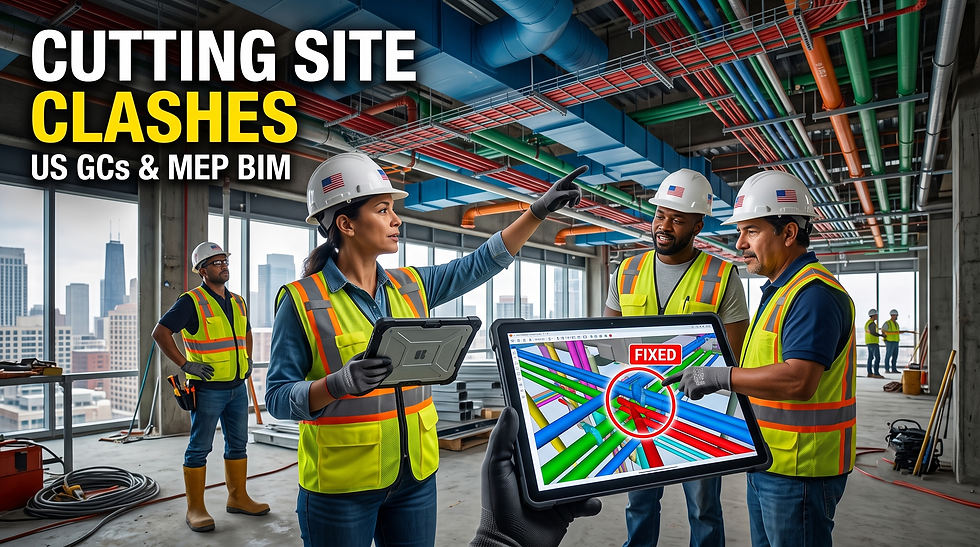
With BIM coordination models, teams can see the systems and detect clashes before the installation in the field gets started.
This approach supports the industry goal of achieving zero-rework environments.
Achieving Zero-Rework Construction Environments
The ultimate goal of AI-powered coordination is eliminating rework during construction.
This can be achieved through:
• Early clash detection
• Predictive design analysis
• High-quality MEP modeling
• Automated coordination workflows
With such practices, prefabricated components can be manufactured precisely and installed without any need for modifications.
This also improves sustainability by reducing material waste and carbon emissions.
Why Accurate BIM Models Are Essential for AI Clash Detection
While AI-assisted clash detection for MEP systems offers powerful automation, its effectiveness depends on the quality of the underlying 3D model.
Accurate models are essential for effective AI coordination. This is why many engineering teams rely on high-quality BIM modeling services for ensuring that their digital models are structured, precise, and ready for automated clash detection.
Here, the principle of 'garbage in, garbage out' fully applies.
If BIM models include errors, inaccurate geometry, or poor labeling, AI tools may generate false clashes or miss critical conflicts.
That's why high-quality baseline modeling is important for successful AI implementation.
Base for AI-Powered MEP Coordination - PrimaVerse
For AI tools to function correctly, BIM models must be precise, well-structured, and highly detailed. Along with BIM coordination, professional mechanical drafting services help ensure mechanical systems are accurately modeled and integrated within the overall building design.
PrimaVerse provides the foundational MEP modeling services required for AI-powered workflows.
Through accurate modeling and strong MEP BIM coordination, PrimaVerse ensures:
• Reliable AI-driven clash detection
• Clean, structured BIM datasets
• Accurate routing of mechanical systems
• Improved constructability analysis
Organizations adopting AI-assisted clash detection for MEP systems rely on precise modeling services to ensure accurate coordination results.
The Future of AI in BIM and MEP Coordination
AI is redefining coordination workflows across the AEC industry.
Some of the most important BIM trends 2026 include:
• Predictive clash detection
• Automated coordination workflows
•Collaboration of cloud-first BIM
• AI-assisted constructability planning
As these technologies mature, AI-assisted clash detection for MEP systems will continue to shape the future of digital construction.
AI-powered coordination is transforming construction workflows, but the success of these technologies depends on accurate BIM modeling.
PrimaVerse provides the high-quality MEP models required for reliable AI-assisted clash detection for MEP systems workflows.
Contact PrimaVerse today to ensure your BIM models are ready for the future of AI-driven construction coordination.
FAQs
1. What’s AI-assisted clash detection in MEP?
AI-assisted clash detection means you let AI scan your BIM models and pick out any conflicts between the mechanical, electrical, and plumbing systems. You don’t have to go searching for these problems by hand anymore, AI automates the process.
2. How does AI make MEP BIM coordination better?
AI goes through your BIM data and instantly finds clashes, so you don’t get stuck on the little stuff. You get more time to solve problems early on instead of putting out fires later.
3. What is the difference between hard clashes and soft clashes in BIM?
Hard clashes occur when two objects physically occupy the same space in the model. Soft clashes are less obvious like when there’s not enough clearance to reach a valve or service panel, or access is blocked altogether.
4. Why bother with clash detection in construction?
The clashes can be spotted before construction starts, not after. This way it saves you from any kind of rework, keeps your schedule on track, and really cuts down on headaches.
5. What’s AI doing for BIM in 2026?
In 2026, AI enables predictive design, automated clash detection, and real-time project coordination. It’s streamlining BIM and helping projects run smoother than ever.
6. What does “cloud-first BIM” mean?
Cloud-first BIM means your whole team can jump into the BIM model at the same time, from anywhere. Teams no longer need to exchange large files or track version histories manually - updates are instantly visible to everyone.
7. Will MEP coordinators be entirely replaced by AI?
Not at all. AI excels at identifying conflicts, but experienced professionals are still required to evaluate solutions and make final decisions.
8. How does AI cut down on construction rework?
By catching issues before crews even show up on site, AI stops a lot of mistakes from turning into expensive fixes later.
9. Why do AI systems need accurate BIM models?
AI is only as good as your BIM data. If the model isn’t right, the AI can’t find the issues that matter. Accurate models mean trustworthy results.
10. How does PrimaVerse help AI-driven BIM workflows?
PrimaVerse delivers precise MEP modeling, which gives AI the clean, solid data it needs to spot clashes and keep your project on schedule.



Comments