Stormwater Management Drafting for First-Round Approval

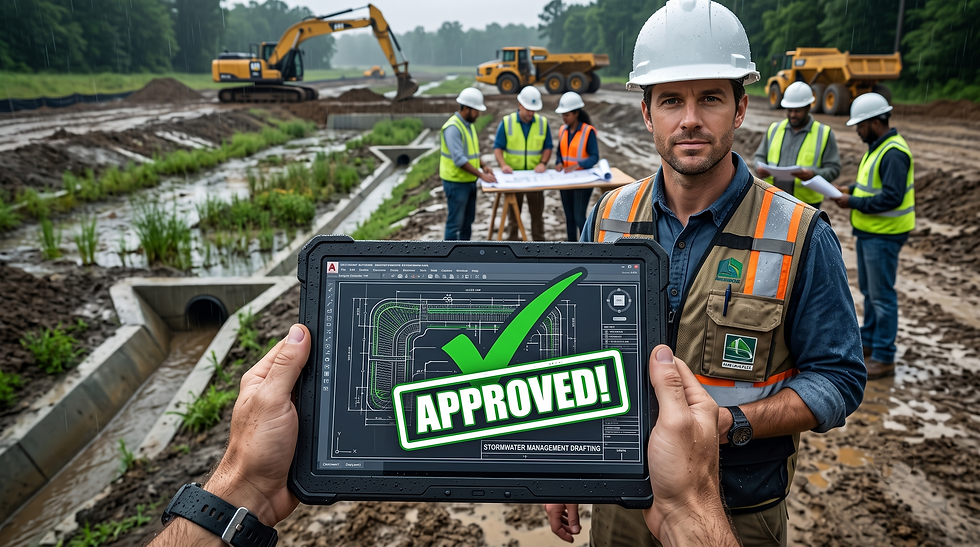
Here's the thing about stormwater management. It's probably the most drafting-heavy part of any land development package you'll touch. And it's also the part that gets kicked back the most on first submission.
Look, this isn't because engineers don't know the rules. It's because the rules come from three directions at once. You've got federal requirements, state programs, and local ordinances, all stacked on top of each other. Miss one layer, and the reviewer sends your package right back.
This post walks through what a complete, first-round-approvable stormwater management package actually needs. It's written for civil engineers, land developers, and project managers who put these packages together regularly and want a clear reference, not a legal textbook.
Every complete package starts with a strong stormwater drainage plan and builds out from there, sheet by sheet, until the whole thing tells one consistent story. Get that sequence right, and reviewers move through your submission a lot faster.
The Regulatory Layers You're Drafting Against
Truth is, you can't draft a clean package without understanding where the requirements come from. The EPA's Construction General Permit sets the federal baseline. It applies to any site disturbing an acre or more of land.
On top of that sits NPDES Phase II. This is where states and municipalities get authority to run their own stormwater permit draftings programs, with conditions that go beyond the federal minimum.
State programs sit in between, and they vary more than most engineers expect. Some states run their own delegated NPDES program directly and issue their own construction permits. Others leave most of the review to counties and cities, stepping in only to set broad technical standards. Either way, find out which agency actually reviews your submission before you start drafting, not after.
Then you've got local ordinances. Bottom line, this is usually the layer that trips people up. Counties and municipalities across the US each run their own submission checklists, their own sheet requirements, and their own review comments. A package built for one jurisdiction rarely transfers cleanly to another without real changes.
The SWPPP: Your First Line of Defense in Review
Every stormwater management submission starts with the Stormwater Pollution Prevention Plan. Reviewers open this sheet first, so it needs to be right.
Solid SWPPP drafting starts with the site map, showing drainage areas and discharge points marked clearly. It also needs the construction sequence, laid out phase by phase, with erosion and sediment control measures noted at each stage. A reviewer wants to see what's protecting the site on day one, not just at final stabilization.
Don't skip the BMP legend. And don't skip the inspection and maintenance schedule either. We see this a lot: engineers build a strong site map, then forget the maintenance schedule entirely. That single missing piece can trigger a full resubmission cycle, even when the rest of the SWPPP drafting is solid.
Take a mid-size subdivision site as an example. It might need six or seven construction phases mapped out, each with its own erosion control layout. Silt fence and inlet protection go in early.
Permanent stabilization measures show up only in the final phase. If your sequence skips a phase or shows measures out of order, that's exactly the kind of thing a reviewer flags on page one.
Drainage Design Drawings: Where Reviewers Dig Deepest
This is the technical core of the package. A proper stormwater drainage plan needs pre-development and post-development drainage area maps, each one with runoff calculations tied directly back to it.
Detention basin design draftings come next, and reviewers check these closely. Outlet structure details matter here. So does the inflow and outflow hydrograph analysis, which shows how the basin actually performs during a storm event, not just its size on paper.
Emergency spillway design rounds out this section. Skip it, and even a well-calculated basin will get flagged. Reviewers want proof that water has somewhere to go if the primary outlet structure can't keep up on its own.
Good detention basin design draftings also show freeboard, principal outlet sizing, and any multi-stage riser details, all clearly labeled on the sheet. Reviewers often check these numbers line by line against your hydrograph output, so keep the drawing and the calculation package pointing to the same figures.
Grading Plans and Erosion Control: The Cross-Check Sheets
Here's where a lot of packages fall apart, even good ones. Grading plans need proposed contours, spot elevations, and flow arrows, and they need enough of them. A reviewer checking your stormwater management calculations against the grading plan should be able to trace water from every point on site to its discharge location, just by following the arrows.
If the flow arrows don't match the stormwater drainage plan and its runoff numbers, that's an instant comment. This happens more than people think, especially on sites with complicated grading.
Good civil stormwater CAD practice keeps grading and erosion control sheets on the same base file. That way, a contour edit updates everywhere at once, instead of leaving one sheet out of sync with the other.
Erosion and sediment control plans are the other cross-check sheet. Every BMP needs its type, its location, and its installation standard spelled out. Vague callouts like "silt fence as needed" don't pass review in most jurisdictions anymore.
Reviewers check these BMP callouts against your stormwater permit draftings conditions line by line, especially in jurisdictions that use numeric BMP sizing tables instead of general standards.
The Calculations Behind the Drawings of Stormwater Management
None of these sheets stand on their own. They're backed by calculations, and reviewers check the math against the drawings constantly.
The rational method still shows up on smaller sites, while the SCS curve number method handles larger or more complex watersheds. Hydrograph routing connects the two, tracking how runoff moves through the site and into your detention basin design draftings.
Bioretention cell design and outlet structure design both need their own detailed calculations too, not just a note referencing a manual somewhere else. And don't treat post-construction stormwater management as an afterthought. Many jurisdictions now review long-term maintenance and water quality performance as closely as they review construction-phase erosion control.
Show your assumptions on the sheet itself, not just in a buried appendix. Curve numbers, times of concentration, and design storm frequency should all be visible right next to the calculation they feed. A reviewer shouldn't have to hunt through a separate report to check your logic.
Good civil stormwater CAD work ties all of this together. Your calculations, your grading, your SWPPP, and your basin details all need to tell the same story across every sheet.
Why Firms Outsource Their Stormwater Drafting Packages
Truth is, most firms aren't short on engineering knowledge. They're short on drafting hours. A stormwater management package touches five or six different sheet types, and each one takes real time to build and cross-check.
That's why a lot of engineering firms bring in dedicated support for stormwater permit draftings, especially when they're running several projects with overlapping deadlines. It's not about cutting corners. It's about freeing up licensed engineers to focus on design decisions instead of sheet production.
PrimaVerse works with US civil engineering firms on exactly this kind of support, handling civil stormwater CAD production for SWPPP drafting, drainage design, and grading packages built to match local submission checklists. Their drafters build directly to jurisdiction-specific requirements, so your engineers spend less time on redlines and more time on design. If your team is juggling multiple concurrent projects under tight deadlines, that's worth a look. You can see their work at primaverse.com.
Getting It Right the First Time
Stormwater management drafting isn't complicated once you see the full picture. Federal rules set the floor. State and local rules build on top. And your SWPPP, drainage plan, grading, and erosion control sheets all need to align with each other for calculations.
FAQs
What is a stormwater management plan and why is it required?
It's the plan that shows how stormwater will move through a site before, during, and after construction. Most agencies won't issue permits until they're satisfied the design meets their drainage requirements.
What is the difference between a SWPPP and a stormwater management plan?
A SWPPP is focused on keeping sediment and pollutants out of nearby waterways while construction is underway. A stormwater management plan looks at the site's overall drainage, including how runoff will be managed after construction.
Why do stormwater permit submissions get rejected on the first try?
More often than not, it's because something doesn't match. If the grading plan, drainage drawings, and calculations don't agree, reviewers will ask for revisions.
What does NPDES Phase II require for construction sites?
It generally applies to projects disturbing one acre or more. Depending on where you're building, the permitting authority may have additional requirements on top of the federal rules.
What is the difference between a detention basin and a retention basin?
A detention basin holds water temporarily and drains after a storm. A retention basin is designed to keep water year-round.
What calculations are required for stormwater drainage design?
Every project is different, but runoff calculations, detention sizing, and outlet design are part of most stormwater submissions.
What BMPs are required in an erosion and sediment control plan?
Common BMPs include silt fence, inlet protection, stabilized construction entrances, and sediment control measures. The final list depends on the site's conditions and local standards.
How long does stormwater permit approval typically take?
That depends on the reviewing agency. A complete submission can move through quickly, while revisions often add weeks or even months.
Do all construction projects need a SWPPP?
No. Federal rules usually require one for projects disturbing an acre or more, but some states and local jurisdictions use lower thresholds.
What is post-construction stormwater management and why does it matter?
It covers how runoff will be managed once construction is finished. That usually means permanent drainage features and a plan to keep them working over time.


Comments